Interview Questions:
“How would you define family?”
“Has your definition of family changed throughout your lifetime? If so, when and why?”
“Which relatives did you have contact with growing up?”
“Who do you consider to be part of your family now?”
“Did your upbringing shape the way that you raised (or would raise) your own family?”
“How did divorce impact your childhood and/or your idea of family?”
Generational Differences:
My parents both defined family in a very traditional sense when they were younger. Their definitions included members of their nuclear families (mother, father, and siblings), and highlighted marriage and children as key features. They both alluded to some change in their definition of family after their divorce later on in adulthood. Their views shifted from a combination of exclusionist and moderate to strictly moderate, as marriage no longer remains part of the definition of the family.
On the other hand, my brother detailed more of an inclusionist perspective when giving his definition of the family. He made sure to include Buddy (our dog) and Dina (a very close family-friend also referred to as a “second mom”) in his definition of the family, and remembers thinking of them as family from a young age. As he progressed through adulthood, he mentioned including even more close friends into his definition of family. He said that the divorce of his parents widened his perception of what can be considered a family, as he received support from many people during a time when his parents couldn’t fully be there for him.
Shifting Societal Norms:
Why did my parents and my brother define family in such different ways? Why were my parents rigid in their definitions, while my brother was broad and adaptable? The answers to these questions are apparent when examining broader societal patterns of change in the definition of family.
Prior to the 20th century, a family in American was considered a married husband and wife, along with their biological children and extended family members. Divorce was not common and couples rarely had children outside of marriage. Strict gender roles meant women stayed home and took care of the children and husband, while men worked and provided for their families as the breadwinners.
Over time, social and legal changes gave women more independence both at home and in the workforce. Family dynamics shifted, with an increase in divorce rates and woman-ran households. However, by the mid-1900s, the standard nuclear family returned. The typical American family featured a breadwinning husband and housekeeping wife who also cared for the children. A close-knit and stable family was seen as the “ideal.”
Decades later, families have become more racially, ethnically, religiously, and structurally diverse.
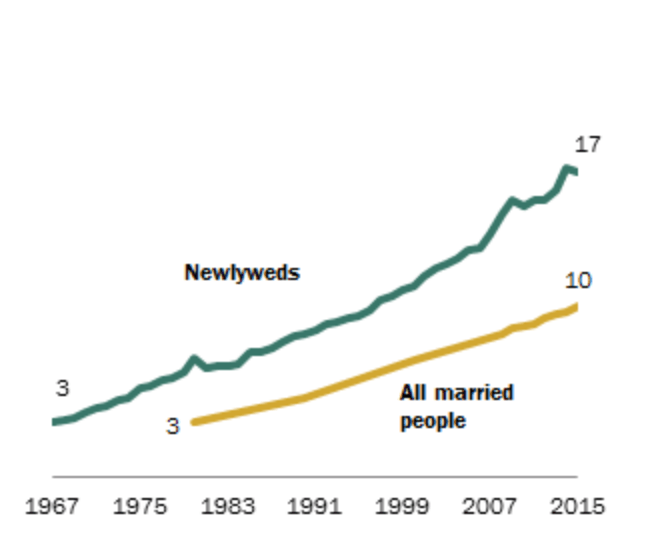
The number of interracial marriages has been consistently increasing since its legalization in 1967. In 1967, 3% of marriages were between partners of different races or ethnicities. In 2015, the number was more than five times higher at 17%. Demographer Daniel Lichter says, “Over the next 20 years, the racial and ethnic composition of scholars studying family changes is going to be much different than we see in this room today.”
In 2017, Census data found about 1.1 million US adults were married to somebody of the same-sex. Further, around 3.7 mullion children had an LGBTQ parent and 200,000 of then were being raised by a same-sex couple.
The proportion of children living in a two-parent household is at a record-low of 69%, compared to 87% in 1960.
In conclusion, the definition of family has changed over time, becoming more complex in form and ambiguous in boundaries. Generational differences in the definition of family correspond with shifts in social norms over time.
 The Robbins Nest