Interview Questions:
“Did you always see marriage and children in your future? If so, what did this look like for you?”
“Do you plan to get married? Why or why not?”
“Do you think that a woman should change her last name when getting married? Has your opinion changed after going through a divorce?”
Generational Differences:
My parents both saw marriage and children in their future from a young age. Their responses indicated that these were assumed milestones during the majority of their lives. Further, they seemed to have felt an immense amount of pressure to accomplish these goals as early as possible.
“Oh yes, I always wanted to be a wife and a mother. I never ever questioned that. I remember when I was really little, maybe six years old, I would put on these little white dresses and sing ‘here comes the bride all dressed in light’ as I walked down an imaginary aisle with my imaginary groom.” – Stacey Robbins
“For most of my life, I believed I had to be married and have kids to be successful.” – Seth Robbins
Dissimilarly, my brother explicitly stated that he was in no rush to reach these milestones. He explained that a healthy and stable relationship has always been of upmost importance to him, with or without the “marriage” label. He expressed a desire to have children one day, possibly in the far future when his lifestyle aligns more with his idea of fatherhood.
Shifting Social Norms:
Why did my parents and my brother voice such different opinions about marriage? Why were my parents so eager to wed from a young age, while my brother remains skeptical into later-adulthood? The answers to these questions are clear when looking at broader societal patterns of change in notions of marriage.
The average age of first-time marriage in America has steadily increased over the past few decades. According to the U.S. Census Bureau, the median age of first marriage in 1990 (when my parents got married) was 23.9 for women and 26.1 for men. The median in 2018 was 27.8 for women and 29.8 for men.
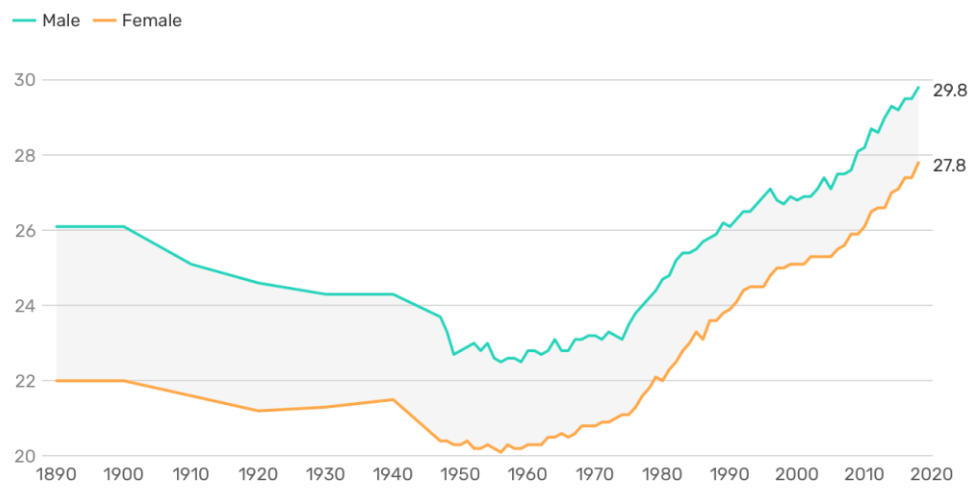
Less than half of U.S. adults are currently married, which marks an all-time low. Seemingly related, the prevalence of alternative adult living arrangements has been on the rise. In particular, cohabitation has become a more common choice than marriage for young adults. Between 1990-2010, there was an 138% increase in unmarried cohabiting couples. In 2016, about 18 million Americans were living with an unwed partner, a 29% jump from 2007.
Public attitudes towards marriage have also changed over time. In the late 1900s, the institution of marriage was supported by the majority. In 2014, Pew Research Center found that 2/3 of millennials think that society is just as well off if people have other priorities besides marriage and childrearing.
In summary, marriage is a continuously evolving institution. Generational differences in views on marriage directly correspond with shifts in social norms over time.
 The Robbins Nest