Interview Questions:
“How did you and your (ex) partner meet?”
“What do you look for in a partner?”
“Is it important to you that your partner shares your same values?”
“Did divorce (or witnessing divorce) change what you look for in a partner?”
Generational Differences:
My parents explained that they met when they took the same course together as freshmen in college. They said that their friendship blossomed into something more because they discovered countless similarities between them. Some examples that they both mentioned include growing up in New York, being Jewish, becoming independent from a young age, being academically driven, and having career ambitions in the field of business. My parents both stressed the importance of finding somebody with the same upbringing and values. Education level and physical proximity also seemed to be important factors for their partner choice.
My brother shared that he was not in a steady relationship for much of his early-adulthood. He remembered feeling unsure of what he wanted from a potential partner throughout high school and college. He met his current girlfriend of four years through mutual friends. He said that they hit it off because they balance each-other out in many ways. He contrasted his loud and outspoken personality with her quiet and reserved mannerisms. While he did point out a few similarities between them, like their equally large appetites and extensive knowledge of historical events, he highlighted their differences as what brought them together. They differ in their religions, political parties, careers, and more. Needless to say, my brother did not feel that similar upbringing and values were important factors when considering potential partners.
“I love the challenge of seeing the world through her eyes. It makes life fun and exciting.” – Matthew Robbins
Shifting Social Norms:
Why did my parents and my brother meet their partners at different stages of their lives? Why did my parents look for people with similar backgrounds, while my brother did not? The answers to these questions are evident when observing broader societal patterns of change in partner choice.
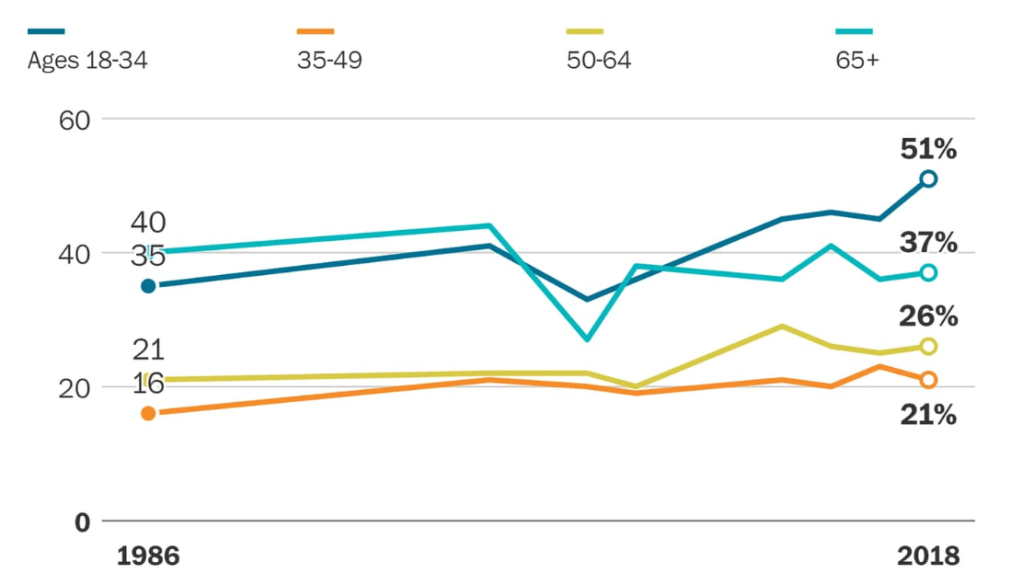
First, a 2018 study of Americans aged 18-34 found that 51% are not involved in a steady relationship. This number is significantly higher than than that when the question was asked in 1986. Many researchers believe that this trend may be due to younger adults “playing their field,” now that the dating pool has increased exponentially through access to online dating apps. Further, these resources overcome the restraint of physical proximity that limited partner choice in the past.
In addition, studies looking at how people met their partner over time have found that a rise in interracial, interreligious, and mixed education-level partnerships over time.
Overall, trends in dating and partner choice change from one generation to the next. Generational differences in partner choice directly correspond with shifts in social norms over time
 The Robbins Nest